
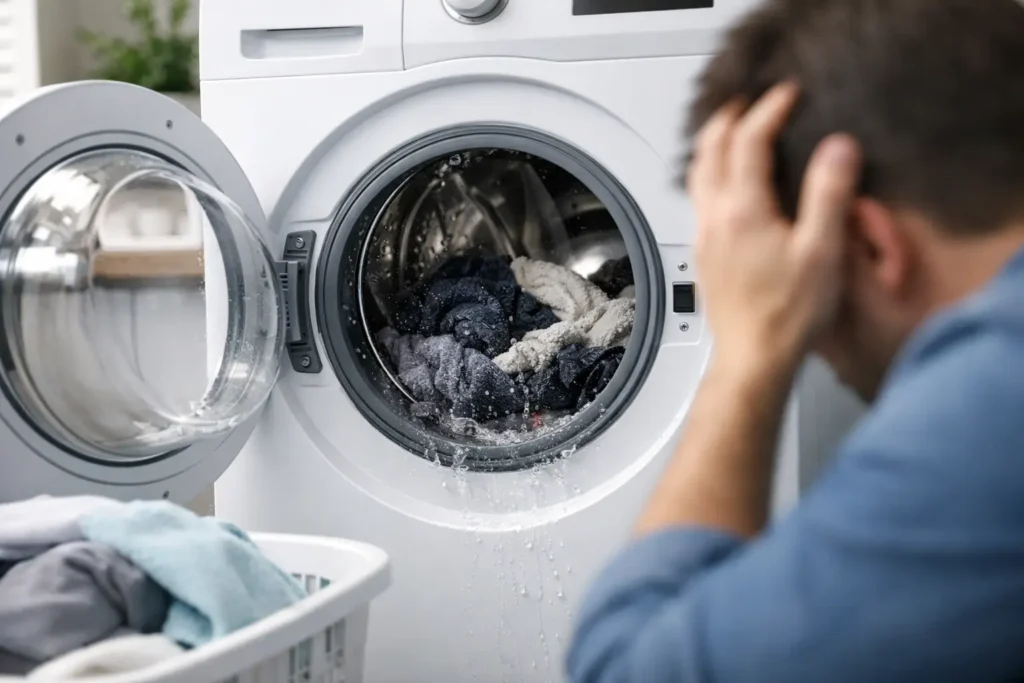
A washer that drains but stops short of spinning creates a very specific kind of problem. The water is gone, but the clothes are still heavy, soaked, and nowhere close to ready for the dryer. For most households, that means laundry backs up fast. For property managers and businesses, it means complaints and downtime.
The good news is that when a washer not spinning but drains, the problem is often isolated to a few common parts or control issues. The less good news is that some of those failures involve safety systems, drive components, or electrical testing that should be handled by a trained technician. The right next step depends on what the machine is doing before, during, and after the drain cycle.
When a washer not spinning but drains, what it usually means
If the washer drains normally, that tells you part of the machine is still working as designed. The drain pump may be functioning, the control may still be advancing through parts of the cycle, and the unit may still have power. Spinning is a separate action that depends on other systems working together.
On many washers, the machine will only spin if it senses that the lid or door is safely locked, the tub is balanced, the motor can engage properly, and the control board is receiving the right signals. If any one of those pieces fails, the washer may drain and then stop, hum, pause, or leave the load wet.
That is why two washers with the same symptom can need completely different repairs. One may only have an off-balance load. Another may need a new lid switch, drive belt, clutch, actuator, motor coupling, or control board.
Start with the simple checks first
Before assuming a major repair, check the basics. An uneven or overloaded wash load is one of the most common reasons a washer skips the spin cycle. If heavy items like towels, jeans, or blankets bunch up on one side, the machine may stop spinning to protect itself from damage.
Open the washer, redistribute the load, and try a spin or drain-and-spin cycle again. If the washer works normally after that, the issue may not be a failed part. It may simply be load balance.
You should also confirm that the cycle settings are correct. Some delicate or hand-wash cycles use slower spin speeds, and some no-spin options can be selected by mistake. It sounds basic, but it is worth checking before going further.
If the washer has recently been moved, make sure it is level. A machine that rocks or tilts can trigger balance-related spin problems, especially on newer models with more sensitive controls.
The door or lid lock may be the issue
One of the most common causes of a washer draining but not spinning is a failed door lock or lid switch assembly. Top-load and front-load machines both rely on safety interlocks. If the washer cannot confirm that the lid or door is secured, it may drain but refuse to spin at full speed.
Sometimes this problem is obvious. The lid does not click into place, the door lock light blinks, or the machine pauses and never enters spin. Other times the switch is failing intermittently, which makes the problem harder to catch without testing.
This is a repair that often looks simple from the outside, but diagnosis matters. Replacing the wrong lock component or assuming the switch is bad without testing can waste time and money. A certified technician can confirm whether the issue is the latch, wiring, strike, or control response.
Drive parts wear out over time
A washer needs mechanical force to spin the basket. Depending on the model, that force may rely on a drive belt, motor coupling, clutch, stator, rotor, shift actuator, or transmission-related components. When one of these parts wears down or breaks, the machine may still drain because pumping water out is a different function than spinning the drum.
With some top-load washers, a worn belt or motor coupling can cause the washer to agitate weakly or not spin at all. With certain front-load models, failing rotor or stator components can prevent proper drum movement. In other cases, a worn clutch may let the tub move partially but not reach full spin speed.
This is where symptom details help. If the washer makes a humming sound, struggles to turn, smells hot, or spins only with very small loads, that points more toward drive-system trouble than a simple balance issue.
A clogged drain system can still affect spinning
It sounds backward, but a washer can appear to drain and still have a drainage-related problem that interferes with spinning. If the pump is weak, the drain hose is partially blocked, or the pressure system is not reading water level correctly, the washer may decide there is still too much water inside to spin safely.
You might notice water draining slowly, a longer-than-normal cycle, gurgling, or a tub that feels wetter than usual at the end. On some machines, even a partial restriction is enough to stop the high-speed spin phase.
The pressure switch and pressure hose can also cause trouble. These parts help the washer sense how much water remains in the tub. If they give the wrong reading, the machine may never transition into spin even when the water has mostly drained.
Control and sensor problems are common on newer washers
Modern washers are more efficient, but they are also more dependent on electronic controls and sensor feedback. If the control board, motor control, speed sensor, or shift actuator fails, the washer may complete part of the cycle and stall before spin.
In these cases, the machine may show an error code, lock and unlock repeatedly, or behave inconsistently from one load to the next. Electronics-related issues are rarely good guesswork repairs. The machine needs proper diagnosis so the faulty part is identified the first time.
That matters for two reasons. First, control boards and sensors are not inexpensive. Second, replacing a board without confirming the root cause can lead to repeat failures if the real problem is in the wiring, motor, or locking system.
What you can safely do before calling for service
There are a few checks that are reasonable for a homeowner or property manager to handle. Unplug the washer first. Then verify the load is balanced, check for obvious door or lid closure issues, inspect the drain hose for kinks, and look for error codes on the display.
If your model has a filter access panel and the manufacturer allows homeowner cleaning, a clogged pump filter may be worth checking. Be prepared for water to come out when it is opened. If you are not sure where the filter is or whether your machine has one, it is better not to force panels open.
Beyond that, most spin-related repairs move into areas where professional service is the safer call. Testing switches, motor circuits, capacitors, or control outputs without the right tools can create more damage or expose you to electrical risk.
When it is time to call a professional
If the washer drains but still leaves clothes soaked after you rebalance the load and confirm the settings, service is usually the next step. The same is true if the machine is making unusual noises, showing repeated error codes, failing intermittently, or stopping mid-cycle.
For households, fast repair means getting back to routine without losing days to trial and error. For landlords, building managers, and small businesses, a correct diagnosis helps avoid repeat visits and longer outages. A washer problem that looks minor can turn into a bigger repair if the machine is forced through repeated cycles while a drive or lock component is failing.
That is why professional diagnosis matters. The goal is not just to get the washer moving again. It is to identify the exact cause, explain the repair clearly, and complete the work safely with upfront pricing after diagnosis.
If you are in Northern New Jersey or nearby service areas in New York and Connecticut, United Technical Services provides certified, fully insured appliance repair with fast scheduling and clear communication. When a washer stops spinning, getting it done right the first time saves time, protects the machine, and reduces disruption.
Is repair worth it?
Usually, yes, but it depends on the washer’s age, brand, and failed part. A lid switch, belt, actuator, or pump-related issue is often very repairable. A transmission or major control failure on an older machine may require a closer cost comparison.
That is where honest diagnosis makes the decision easier. You should know what failed, what it takes to fix it, and whether the repair is a smart investment before any work moves forward.
A washer that drains but will not spin is not a small inconvenience for long. Wet laundry piles up quickly, and the real issue is often more specific than it appears. A careful check may rule out something simple, but if the problem keeps happening, professional service is the fastest path back to a washer you can count on.