
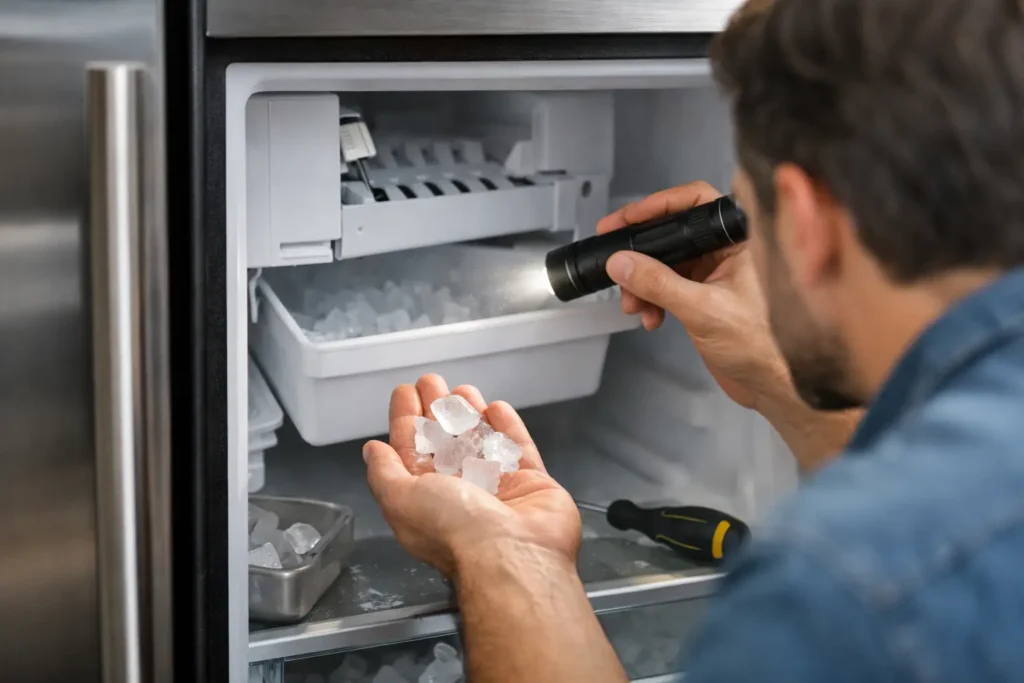
When the bin is empty and the freezer looks fine, frustration sets in fast. Ice maker not making ice troubleshooting usually comes down to a short list of causes – temperature, water supply, a blocked fill line, a bad shutoff arm, or a failed component inside the assembly. The key is knowing what you can check safely and when it makes more sense to schedule service before food storage or daily routines get disrupted.
Ice maker not making ice troubleshooting starts with the basics
Before assuming the ice maker itself has failed, check the conditions it needs to operate. Most units need the freezer to stay cold enough, usually around 0 to 5 degrees Fahrenheit, before they will cycle normally. If the freezer is sitting too warm, the refrigerator may still seem cold enough for food while the ice maker quietly stops producing.
Next, confirm the ice maker is actually turned on. That sounds obvious, but it is one of the most common causes after a recent cleaning, a filter change, moving groceries around, or a door left open long enough to trigger a temporary issue. Depending on the model, the control may be a metal arm, a toggle switch, or an electronic setting on the display panel.
Then look at the shutoff arm and ice bin. If the arm is stuck in the raised position or the bin is misaligned, the unit may think it is full and stop cycling. This is especially common when cubes freeze together and jam the mechanism.
Check freezer temperature before anything else
Temperature drives everything. If the freezer is above the proper range, the ice maker may not harvest cubes, may not fill, or may produce very small batches. Put a thermometer in the freezer if the display seems questionable. Built-in temperature readouts can be helpful, but they are not always perfectly accurate.
If the freezer is too warm, the problem may not be the ice maker at all. Dirty condenser coils, a failing evaporator fan, poor door sealing, blocked vents, or frequent door openings can all reduce cooling performance. In that situation, replacing the ice maker would not solve the real issue.
There is a trade-off here. If your freezer is only slightly warm, you might still get occasional cubes, which makes the problem seem intermittent. That often leads people to chase the wrong part. Consistent temperature should be confirmed first.
Make sure water is reaching the ice maker
An ice maker cannot produce ice without steady water pressure. Pull the refrigerator forward carefully and inspect the water line behind it for kinks or crushing. If the line got pinched when the unit was pushed back into place, water flow may be reduced or fully blocked.
Check the household water supply valve too. It should be fully open. A partially closed valve can create slow fills, hollow cubes, or no cubes at all. If your refrigerator dispenses water through the door and that flow is weak, it is a strong clue that water delivery is the problem.
If the dispenser works normally but the ice maker does not, the issue may be more specific to the fill system. A frozen fill tube, a bad inlet valve, or a control problem may be preventing water from entering the mold.
The water filter may be part of the problem
A clogged refrigerator water filter can slow flow enough to affect ice production. This is especially common when the filter is overdue for replacement or when an aftermarket filter does not seat properly in the housing.
Some models will still dispense drinking water with a restricted filter, but the ice maker may stop first because it depends on a timed fill. Not enough water enters the mold, so cubes come out undersized or production stops completely. If your filter is old, replacing it with the correct filter for the model is a reasonable first step.
If the issue starts right after a filter replacement, remove and reinstall the filter carefully. A filter that is not locked into place can interrupt water flow. On some units, trapped air in the line also needs to be purged by running the dispenser for a minute or two in short intervals.
Watch for a frozen fill tube or jammed cubes
Open the ice maker area and inspect the fill tube where water enters the mold. If that tube is frozen solid, the ice maker cannot fill. This can happen because of a seeping inlet valve, low freezer airflow, or temperature irregularities.
You may also see cubes stuck halfway through harvest or a solid clump in the bin. That points to a mechanical jam or a defrost issue affecting the compartment. Clearing loose ice is often fine, but forcing parts can crack plastic components or knock the timing out of alignment.
This is one of those cases where it depends on what you find. A simple jam may be corrected by emptying the bin and resetting the unit. A frozen fill tube that returns again usually means another part is failing and needs proper diagnosis.
When the ice maker assembly itself is failing
If temperature and water supply check out, the problem may be inside the ice maker assembly. The motor module, mold thermostat, heater, control board, or internal switch can fail and stop the harvest cycle. On newer refrigerators, electronic controls can also interrupt operation without obvious signs.
Typical symptoms include an ice maker that never cycles, clicks but does nothing, cycles without filling, or makes one batch and then stops. Some models have a test mode, but using it without the service procedure can create confusion or lead to the wrong conclusion.
For property managers and business owners, this matters because recurring ice issues often point to a broader refrigeration or control problem. Replacing parts one by one can waste time and increase downtime. Accurate diagnosis is what keeps the repair efficient and done right the first time.
Ice maker not making ice troubleshooting for side-by-side and French door models
Different refrigerator styles fail in different ways. Side-by-side units often have issues related to airflow, frozen fill tubes, and freezer-side temperature fluctuation. French door models with ice makers in the refrigerator compartment may be more sensitive to door sealing, fan operation, and sensor problems.
Built-in and premium models can add another layer. Their controls are more complex, and ice production may pause because of software, sensor, or valve issues that are not obvious from the outside. If you have a high-end refrigerator, guessing can get expensive quickly.
That is why a professional diagnosis often saves money compared with trial-and-error repairs. The problem may look like an ice maker failure while the actual cause is a fan motor, inlet valve, thermistor, or control board.
What you can safely do before calling for service
There are a few checks that make sense for most homeowners. Confirm the ice maker is switched on, verify freezer temperature, replace an overdue filter, inspect for a kinked water line, and empty a jammed bin. Those are practical first steps and often enough for simple cases.
What you should avoid is using excessive heat to thaw parts, forcing gears or arms, or disassembling panels around live electrical components and water connections. Refrigerators combine electrical systems, moving parts, and pressurized water lines. A small mistake can turn an ice issue into a leak, broken trim, or a larger cooling problem.
If the unit has stopped making ice for more than a day or two, if the freezer temperature is unstable, or if you see signs of leaking, it is time to move past basic troubleshooting.
When to schedule professional ice maker repair
If your refrigerator has proper power, the freezer is cold enough, and water supply appears normal, but the ice maker still is not producing, the next step is diagnosis by a qualified technician. The same applies if the fill tube keeps freezing, the unit makes partial cubes, or the issue keeps returning after a reset.
For households, fast service means less disruption and fewer repeat problems. For multi-unit properties and commercial spaces, quick repair helps reduce complaints, protect food storage, and restore normal operations without dragging the issue out. That is where clear communication and upfront pricing matter.
United Technical Services provides certified, fully insured appliance repair with fast scheduling and upfront pricing after diagnosis. If your ice maker has stopped working and basic checks have not solved it, professional service can identify the real cause and get the refrigerator back to reliable operation.
A good repair experience should leave you with more than a full ice bin. It should give you confidence that the problem was diagnosed correctly, repaired safely, and handled without wasting your time.